
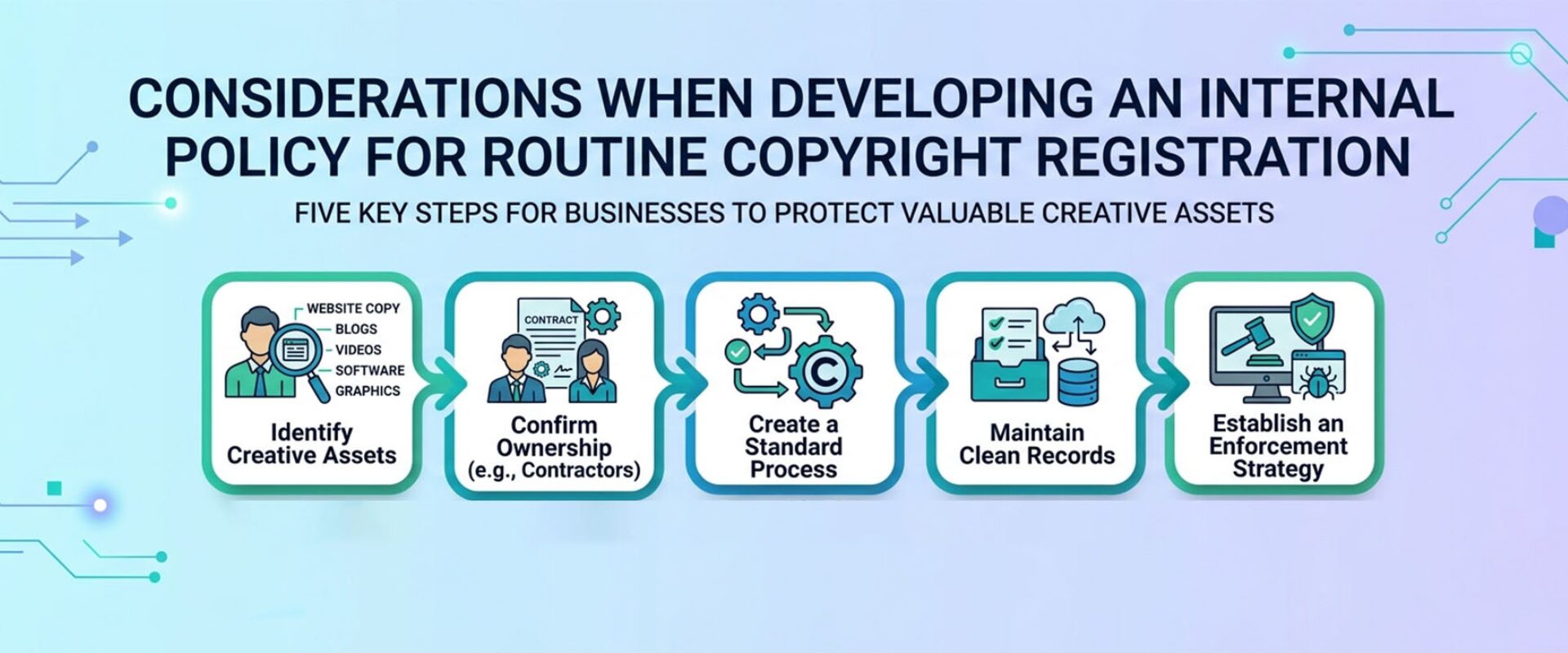
Summary: Businesses create valuable content daily but without a formal copyright registration policy, that content remains vulnerable. This article walks through five practical considerations for building an internal policy: prioritizing high-value assets, confirming ownership (especially for contractor work), creating a repeatable filing process, maintaining clean records, and establishing an enforcement strategy. Register early, document clearly, and act consistently.
Every business, no matter how small, creates valuable content daily. From your website copy, blog posts, product videos, and graphics to software, training materials, and marketing assets, every piece of work carries business value. As these assets support your sales, branding, client education, or product delivery, you should consider how to protect them.
Copyright protection arises when an original work is fixed in a tangible form. Registration, however, can strengthen your legal position if another party copies, misuses, or profits from your work. The U.S. Copyright Office has a massive database of approximately 22 million copyright registration records, from January 1, 1978, through June 27, 2025.
If your work is critical for your business, it should be registered to protect it from unlawful use. A structured internal copyright registration policy is your first step in that direction. It helps your team identify valuable assets, confirm ownership, manage filings, and keep clear records over time.
Here are some key points to consider when developing an internal copyright registration policy for your business.
1. Identify Which Business Assets Should Be Registered
Not every business asset needs registration. For instance, a short social media caption may not carry the same value as a core software product, a flagship video, or a high-performing website page. Your internal copyright registration policy should help your team prioritize assets that carry commercial value, get reused often, or represent your brand in the market.
Typically, these assets may include:
- Website content
- Blogs and articles
- Marketing brochures
- Videos and graphics
- Software and digital products
- Training materials
- Product documentation
- Sales presentations
| Tip: When prioritizing, ask three quick questions about each asset: Is it expensive to recreate? Does it represent your brand? Is it likely to be copied? A “yes” to any one is a strong signal to register. |
You can categorize content by business value. For example, your team may label these assets as high, medium, or low priority. High-priority assets are typically expensive to create, are at the heart of your brand identity, are used in sales, licensed to others, or likely to be copied by competitors.
They may include original software, website content, paid campaign materials, product videos, and even content made using AI.
| Be Aware: Purely AI-generated material is not eligible for copyright registration, because the U.S. Copyright Office requires human authorship. AI-assisted works can be registered, but only for the portions a human meaningfully authored, and that human contribution should be disclosed in the application. |
Your internal copyright registration policy should help you prioritize assets based on their business value, which makes it easier to manage your copyright registration resources.
| What This Means For You: If your team treats every asset the same, you’ll spend the filing budget on low-value content and may overlook the high-value work that genuinely needs protection. A simple high/medium/low tier keeps your money and effort where they matter. |
2. Define Ownership Before Registration
The next consideration is to confirm ownership before filing any copyright registration. This step can prevent legal disputes later.
For example, employee-created content may belong to the employer in many work-related situations. However, contractor and freelancer-created content may be treated differently. Your business may pay for a logo, video, blog post, software code, or design asset, but still face ownership issues if the agreement with the contractor or freelancer does not clearly assign who owns the copyright.
| Common Mistake: Paying a contractor for a logo, video, or code does not automatically make you the copyright owner. Without a signed assignment or a valid work-made-for-hire clause, the freelancer can retain the rights, even though you paid for the work. |
Your internal copyright registration policy should include suggestions for reviewing:
- Employee roles and job duties
- Contractor agreements
- Freelancer agreements
- Work-for-hire language
- Copyright assignment clauses
- Contributor records
Typically, copyright disputes can involve a former contractor claiming ownership of website content, a developer disputing rights to code, or a designer reusing brand assets for another client. Clear agreements can reduce these risks before registration begins.
| Questions To Ask: Before you file, run through three questions for each work: Who actually created each part of it? Is there a signed agreement transferring the copyright to us? Has anything been revised or combined since the last ownership review? |
Additionally, consider reviewing ownership each time your business updates or combines creative work. For example, your team may revise contractor-written website copy, add employee-created graphics to a brochure, or build new software features on top of earlier code.
These contributions can create ownership questions if your records do not show who created each part and how rights were transferred. Your internal copyright registration policy should provide a simple review step before filing so you can confirm that the registration reflects the correct owner, contributors, and version of the work.
3. Create a Standard Copyright Registration Process
A repeatable process can help your business avoid missed opportunities and reduce confusion between departments. Your internal copyright registration policy should define who identifies eligible content, who reviews ownership, who approves filings, and who keeps the registration records updated.
| How It Works: A U.S. copyright registration moves through four basic stages: you file an application, submit a deposit copy of the work, pay the fee, and an examiner reviews the claim before issuing a certificate. The Office measures from the time it receives an appropriate application, the correct filing fee, and a deposit so the effective date is when your complete submission arrives, not when the certificate is mailed. Source: U.S. Copyright Office |
You may consider a workflow like this:
- Marketing, product, or operations teams identify new creative assets.
- A manager reviews whether the asset has business value.
- Legal or outside counsel reviews ownership and registration considerations.
- Approved assets move into a filing schedule.
- Your company records registration details in an internal tracker.
Your business may submit registrations monthly, quarterly, or after major content releases. The right timing depends on your content volume, budget, and risk profile. For example, if your company publishes weekly blogs, videos, or downloadable resources, you might benefit from a regular review cycle. On the other hand, a business that creates fewer but higher-value assets may focus on registration after major campaigns, product launches, or software updates.
With an internal copyright registration policy, you can create a tracking system to maintain consistency. It may include asset title, creation date, publication date, owner, contributors, registration status, filing date, and certificate details.
This record can also help your team see which assets still need review, which copyright registrations are pending, and which works already have protection in place.
4. Maintain Proper Documentation and Records
Good records can support ownership and enforcement. Your internal copyright registration policy should include suggestions for storing key documents in one organized place, such as a shared legal folder, digital asset management system, or internal IP tracker.
Useful records may include:
- Creation dates
- Draft versions
- Final files
- Contributor names
- Contractor agreements
- Licensing agreements
- Publication dates
- Registration certificates
| Key Takeaway: Your records are only useful if they can answer one question fast: who created this, when, and how did the rights come to us? Build that file at creation, not in the middle of a dispute. |
You should also consider documenting how each asset was used. For example, your records may note whether a graphic appeared in a paid campaign, whether a video was published on your website, or whether software code was included in a commercial product.
These details can help show the value and business use of the work. Plus, organized records can help if another party copies your content. They can show when your work was created, who created it, how rights were transferred, and when the work became public.
This documentation can help you respond quickly during infringement disputes. Without clear records, your team may spend valuable time searching email threads, old folders, or vendor files instead of reviewing the claim and deciding the next step.
5. Develop an Enforcement and Risk Management Strategy
Registration can improve your enforcement options. Your internal copyright registration policy should include suggestions for how your business monitors misuse and responds to infringement concerns. This part of the policy can help your team act with more consistency when someone copies or misuses your original work.
Your team may consider monitoring for:
- Website copying
- Blog duplication
- Social media misuse
- Competitor duplication
- Unauthorized software use
- Reuse of videos, graphics, or downloadable materials
Your policy can also explain who reviews suspected infringement. For example, a marketing team may notice copied website content, while a product team may identify unauthorized software use. Your internal copyright registration policy should give those teams a clear reporting path, such as sending the issue to operations, management, in-house legal, or outside counsel.
| Did You Know: You can’t sue for infringement of a U.S. work until the registration is actually complete, not merely applied for. The Supreme Court confirmed this in Fourth Estate Public Benefit Corp. v. Wall-Street.com (2019), another reason to register early rather than after a problem appears. |
The policy can also outline response steps. For example, your team may document the suspected infringement, save screenshots, record URLs, review ownership records, and consult a copyright attorney before sending a cease-and-desist letter. These steps can help your business preserve useful evidence before the copied material changes or disappears.
Some situations may call for a softer response. For example, your business may first request attribution, removal, or correction. Other situations may require legal escalation, especially when the copying affects your revenue, brand trust, software distribution, or competitive position. It can help your team avoid rushed decisions and choose a response that fits the risk.
Build a Consistent Copyright Protection Process
A structured internal copyright registration policy can help your business protect valuable creative assets with more consistency. It can also support ownership clarity, stronger documentation, and more organized enforcement decisions.
| Bottom Line: A copyright policy isn’t paperwork for its own sake. It’s the difference between having enforceable rights when you need them and discovering, mid-dispute, that you can’t fully act on them. |
Your policy should reflect how your business creates, uses, licenses, and shares original content. It should also include practical suggestions for identifying high-value assets, confirming rights, managing filings, and responding to potential infringement.
| Next Step: Pick your five highest-value assets this week and confirm two things for each: who owns it, and whether it’s registered. That short list is the fastest start to a working policy. |
Ludwig APC can help your business evaluate copyright registration considerations and develop long-term protection strategies that fit your operations, content volume, and enforcement needs. Contact us today at (619) 929-0873 or consultation@ludwigiplaw.com to arrange a free consultation to discuss your situation, assess your risks, and outline a path forward.
Frequently Asked Questions (FAQs)
1. Does copyright protection exist even if I never register my work?
Yes, protection is automatic upon creation, but registration is required before you can sue for infringement in the U.S. It also strengthens your ability to recover damages.
2. If I paid a freelancer to create content, do I automatically own the copyright?
No. Payment alone does not transfer ownership. Without a signed assignment or work-for-hire clause, the freelancer may retain rights even after you’ve paid.
3. Can I register AI-generated content?
Not if it’s purely AI-generated. The U.S. Copyright Office requires human authorship. AI-assisted works can be registered, but only for the portions a human meaningfully created, and that must be disclosed in the application.
4. How often should my business file copyright registrations?
It depends on your content volume. High-output businesses may benefit from monthly or quarterly filings; others may file after major launches or campaigns. Consistency matters more than frequency.
5. What should I do if someone copies my content?
Document it immediately using screenshots, URLs, dates. Review your ownership records, then consult a copyright attorney before taking action. Response options range from a removal request to formal legal escalation depending on the severity.


