
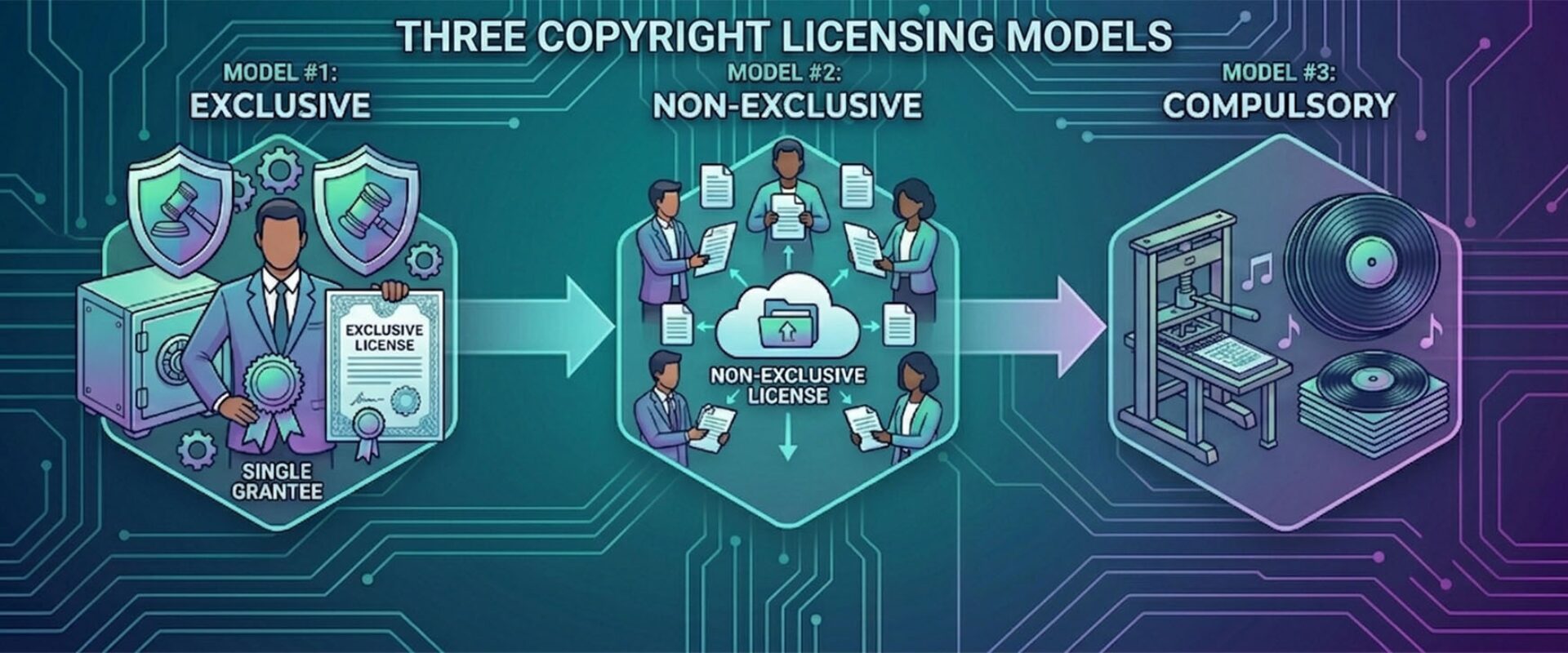
Summary: Copyright licensing turns your creative assets into revenue but the model you choose determines how much control you keep. This article breaks down three models: exclusive, non-exclusive, and compulsory and what each means for your ownership, income, and enforcement rights.
Key Takeaways:
- The three main copyright licensing models are exclusive, non-exclusive, and compulsory (statutory).
- An exclusive license must be in writing and signed to be valid (17 U.S.C. § 204(a)); a non-exclusive license can be oral or implied.
- Only the owner of an exclusive right can sue for infringement of that right (17 U.S.C. § 501(b)), a non-exclusive licensee generally cannot.
- Compulsory licensing is set by statute, mainly under Section 115 of the U.S. Copyright Act for music, with rates fixed by the Copyright Royalty Board.
- The right model depends on your goals: exclusive for high-value strategic deals, non-exclusive for scale, compulsory only where the law applies.
Copyrights can hold significant business value. From written content, software, images, videos, and music to training materials, publications, and digital assets, your creations may support your revenues directly or indirectly. With a clear licensing program, you can control how others use your copyrighted works and create new income opportunities.
Copyright licensing gives another party permission to use any protected work under predefined terms. These terms may cover territory, duration, format, payment, exclusivity, sublicensing, enforcement rights, and termination. If you regularly create or manage content as a part of your business, the right licensing structure can help you manage ownership, revenue, and legal risk.
The three most common copyright licensing models are exclusive licensing, non-exclusive licensing, and compulsory licensing. Let’s explore how these three main types of copyright licenses affect your revenue, ownership control, enforcement rights, and long-term business plans.
Why Copyright Licensing Programs Matter for Your Business
A copyright licensing program helps you control how others use your protected work while creating business value from it. With the right structure, you can earn revenue, reduce misuse, support growth, and prepare for potential disputes.
| Reader Scenario: If you’re a business that already creates content, software, courses, video, written work, but has never formally licensed any of it, you may be giving away value through informal “go ahead and use it” permissions that carry no terms, no payment, and no enforcement path. |
Revenue Generation
With the right type of copyright license, you can turn copyrighted work into a source of income without giving up ownership. You may collect royalties, subscription fees, distribution fees, or other payments. This can help you create long-term value from assets your business already owns.
Risk Mitigation
Clear licensing terms can reduce the risk of copyright infringement and business disputes. Your agreement can define who may use the work, how they may use it, and what uses are prohibited. This helps you respond when a licensee exceeds the agreed scope.
Business Growth
Licensing can help your business reach new markets, platforms, and commercial partners. You may use it to distribute software, publish content, expand media use, or support cross-border commercialization. Strong terms help you grow while keeping control over your copyrighted work.
Legal Readiness
A suitable copyright licensing model can place your business in a stronger position before problems arise. Well-drafted terms can support pre-litigation counseling, enforcement, and litigation if a dispute develops. A seasoned team of copyright attorneys like those at Ludwig APC can help you understand licensing risks and help protect your rights.
Model #1- Exclusive Licensing
This licensing model grants a single licensee exclusive rights to use your copyrighted work within agreed-upon limits. This model can create strong commercial value, but it also affects your control over the work. You should review exclusivity terms carefully before granting these rights.
Key Legal Characteristics
Exclusive licenses should be clearly written. The agreement should define the licensed work, territory, duration, scope, payment terms, and termination rights. Clear language helps you reduce disputes about what the licensee can and cannot do.
Business Use Cases
An exclusive copyright licensing model is common in media distribution, software agreements, publishing, and franchise-style arrangements. You may grant exclusive rights when one partner needs market protection before investing in promotion or distribution. This model can support high-value commercial relationships.
Advantages
This approach may support higher fees because the licensee receives stronger rights. It can also help create deeper commercial partnerships. In some cases, exclusivity gives the licensee a competitive advantage in a defined market.
Risks
The main risk of this copyright licensing model is loss of control. If the terms are too broad, you may lose future licensing opportunities. You may also become dependent on one licensee, especially if that licensee fails to perform or underuses the copyrighted work.
| Common Mistake: Granting “all rights, all territories, forever” in a single exclusive deal. Overbroad exclusivity locks you out of every other market and platform for the life of the term, even if the licensee barely uses the work, which is why performance, audit, and termination clauses matter. |
Legal Counsel Role
Legal counsel can help you draft clear exclusivity clauses and protect your remaining rights. They may also include performance duties, breach provisions, audit rights, and termination terms. These suggestions can help you preserve value while granting exclusive rights.
Model #2: Non-Exclusive Licensing
A non-exclusive license lets you grant rights to multiple licensees while keeping ownership and control. This model works well when your business wants a broader reach, repeat revenue, and flexible use of copyrighted assets. It is one of the most common copyright licensing models for digital assets and scalable products.
Key Features
Non-exclusive licenses are flexible, scalable, and common in digital business models. They can define different use levels, customer types, territories, or platforms. This model works well when the same asset can serve many users without losing value.
Business Applications
Stock media, SaaS, educational content, publishing, templates, and training materials are a few common examples of this copyright licensing model. If you run a software company, you may license the same platform to many users. Likewise, you may license content to several schools, businesses, or platforms as a publisher.
Advantages
This copyright licensing model can help you create multiple revenue streams from the same copyrighted work. It also offers more control as the owner. Since you are not tied to one licensee, your business may reduce dependency risk.
Risks
Non-exclusive licensing can create market saturation if too many parties receive similar rights. It may also reduce the perceived value of the work. Enforcement can become harder when many licensees use the same asset across different platforms.
| Be Aware: Indicators a non-exclusive licensee has exceeded scope: usage on platforms or in regions not listed in the agreement, more users or installs than the license covers, sublicensing or redistribution you never approved, or the work appearing in a product tier you didn’t authorize. |
Legal Considerations
The agreement should define scope, user limits, permitted uses, prohibited uses, and monitoring rights. You should also consider how you will detect unauthorized use. Clear terms can support enforcement if a licensee exceeds the agreed-upon rights.
Model #3: Compulsory (Statutory) Licensing
Compulsory licensing, also called statutory licensing, allows certain uses of copyrighted works under law without direct permission from the copyright owner. This copyright licensing model applies only in specific legal settings. It can affect your control, payment rights, and compliance obligations.
| How It Works: Compulsory licensing lets a user obtain rights directly from the law instead of negotiating with you. Section 115 of the U.S. Copyright Act governs compulsory licensing for phonorecords, ensuring that once a song is published, its reproduction cannot be withheld: the user files the required notice, pays a government-set rate, and may proceed without your consent. Source: UpCounsel |
Legal Framework
This copyright licensing model is governed by national copyright laws, including parts of the U.S. Copyright Act. These rules define when the license applies, what payments are required, and what procedures must be followed. You should not treat statutory licensing as unrestricted permission.
Common Applications
Compulsory licensing often appears in music, broadcasting, and public-interest contexts. It may allow certain uses where direct negotiation would be difficult at scale. These uses still require compliance with statutory rules.
Advantages
This copyright licensing model can support access to copyrighted works while creating standardized compensation for owners. It may also reduce negotiation barriers in industries with repeated or high-volume uses. For some rights holders, it can create a predictable payment structure.
Risks
Copyright owners may have limited negotiation power under this model. They may not control the licensee, price, or certain terms. Users may also face compliance risk if they misunderstand payment, reporting, or notice requirements.
Legal Counsel Role
Legal counsel can help you determine whether a compulsory license applies and what obligations follow. They may also help with royalty disputes, compliance review, and enforcement issues. Your legal team can assist when statutory use exceeds legal limits or creates a dispute.
Key Differences Between the Three Licensing Models
| Issue | Exclusive License | Non-Exclusive License | Compulsory License |
| Consent | The owner grants rights by contract | The owner grants rights by contract | Law permits use if rules are met |
| Control | Lower control during the term | Higher control remains with the owner | Control depends on statute |
| Revenue | Higher fees or guarantees | Multiple income streams | Set or regulated payments |
| Best Use | Strategic deals and market entry | Scaled digital distribution | Music, broadcast, and public access uses |
| Main Risk | Overbroad rights and lock-in | Market saturation and misuse | Compliance failures |
These copyright licensing models differ most in control and risk. Exclusive licenses trade control for a higher value, while non-exclusive licenses favor scale. Compulsory licenses follow legal systems, not private deal terms.
Choosing the Right Copyright Licensing Model
Choosing the right copyright licensing model depends on your business goals, revenue strategy, market pressures, asset type, and desired level of control. For instance, a software company may need non-exclusive customer licenses, exclusive reseller rights in one region, and open source compliance in the same product stack.
| Before You Decide: Before you commit to a model, confirm four things: that you actually own the rights you’re granting, that your registration and chain of title are documented, that contributor and contractor agreements assigned rights to you, and that any platform or open-source terms in your product don’t conflict with the license you’re about to sign. |
Many businesses use hybrid plans. Sometimes, a publisher may grant exclusive print rights in one country and non-exclusive digital rights worldwide. A game studio may license music under statutory rules while using private contracts for art, code, and characters.
That said, legal structure should come before signing. Ownership records, registration status, chain of title, contractor agreements, and platform rules should be reviewed. Depending on your situation, you may also need to record your copyrights with the US and Foreign Customs.
Common Mistakes in Copyright Licensing Agreements
Copyright licensing agreements can create disputes when they leave key terms unclear. Before you sign, you should review how the agreement defines rights, limits, payments, compliance duties, and enforcement options. These considerations can help your business reduce licensing risks and prepare for possible pre-litigation issues.
- Unclear exclusivity language can create confusion about who may use the copyrighted work. The agreement should explain whether the license is exclusive, where exclusivity applies, how long it lasts, and which rights remain with you.
- Failure to define the scope can weaken the agreement. The license should address territory, duration, media, platform, format, users, modifications, sublicensing, and payment terms.
- Ignoring statutory licensing obligations can create compliance problems. If your business uses copyrighted works under a legal licensing system, you should understand reporting, payment, and notice requirements.
- Weak enforcement provisions can make disputes harder to manage. The agreement should explain what happens if a licensee exceeds permitted use, misses payments, shares the work without permission, or fails to stop unauthorized use.
How Ludwig APC Can Help
At Ludwig APC, we work with businesses that need practical copyright guidance linked to commercial goals. We can help you draft licensing agreements, negotiate licensing terms, structure exclusive and non-exclusive arrangements, and manage copyright disputes.
Our firm can also support enforcement and litigation when a licensee breaches an agreement or a third party uses your copyrighted work without permission. This may include pre-litigation counseling, demand strategy, settlement evaluation, and litigation.
As a business that relies on copyrighted assets, a licensing agreement should do more than grant permission. It should protect your ownership, define revenue rights, preserve enforcement options, and support future growth.
Build Copyright Licensing Terms Before Problems Start
Whether exclusive, non-exclusive, or compulsory, each copyright licensing model serves different business and legal functions. The right choice depends on your goals, target market, copyrighted asset, and the level of control you want to maintain.
| Bottom Line: The model you choose matters less than the clarity of the terms you write. A well-drafted non-exclusive license protects you better than a vague exclusive one. |
That said, only well-written agreements can help your business monetize copyrighted works while reducing disputes over ownership, use, payment, and enforcement. Before you enter into a licensing arrangement, consider seeking legal guidance on the deal’s structure, scope, and long-term effects.
| Next Step: Pull your most valuable copyrighted asset and answer one question this week: under what terms is anyone currently allowed to use it? If you can’t point to a written license, that’s where to start. |
Ludwig can help you understand, protect, and leverage your original works. We offer comprehensive services to help you build a protect copyright licensing model and strategy. Contact us today at (619) 929-0873 or consultation@ludwigiplaw.com to arrange a free consultation to discuss your situation, assess your risks, and outline a path forward.
Frequently Asked Questions (FAQs)
1. What’s the biggest practical difference between exclusive and non-exclusive licenses?
Exclusivity means only one party can use the work, commanding higher fees but limiting your future options. Non-exclusive licenses let you grant the same rights to multiple parties, building broader revenue without giving up control.
2. Does an exclusive license need to be in writing?
Yes. Under 17 U.S.C. § 204(a), it must be in writing and signed to be legally valid. A non-exclusive license can be oral or implied, though written agreements are always advisable.
3. Can a licensee sue someone for infringing the work they licensed?
Only if they hold an exclusive right. Under 17 U.S.C. § 501(b), only the owner of an exclusive right can bring an infringement claim. A non-exclusive licensee generally cannot.
4. What is compulsory licensing and does it apply to my business?
Compulsory licensing allows certain uses of copyrighted works under law, without negotiating with the owner. It applies mainly to music under Section 115 of the U.S. Copyright Act. If you’re not in music or broadcasting, it likely doesn’t apply.
5. What’s the most common mistake businesses make in licensing agreements?
Leaving key terms vague around exclusivity, scope, territory, and permitted uses. A well-drafted agreement defines rights, limits, payment, and enforcement options from the start.


