
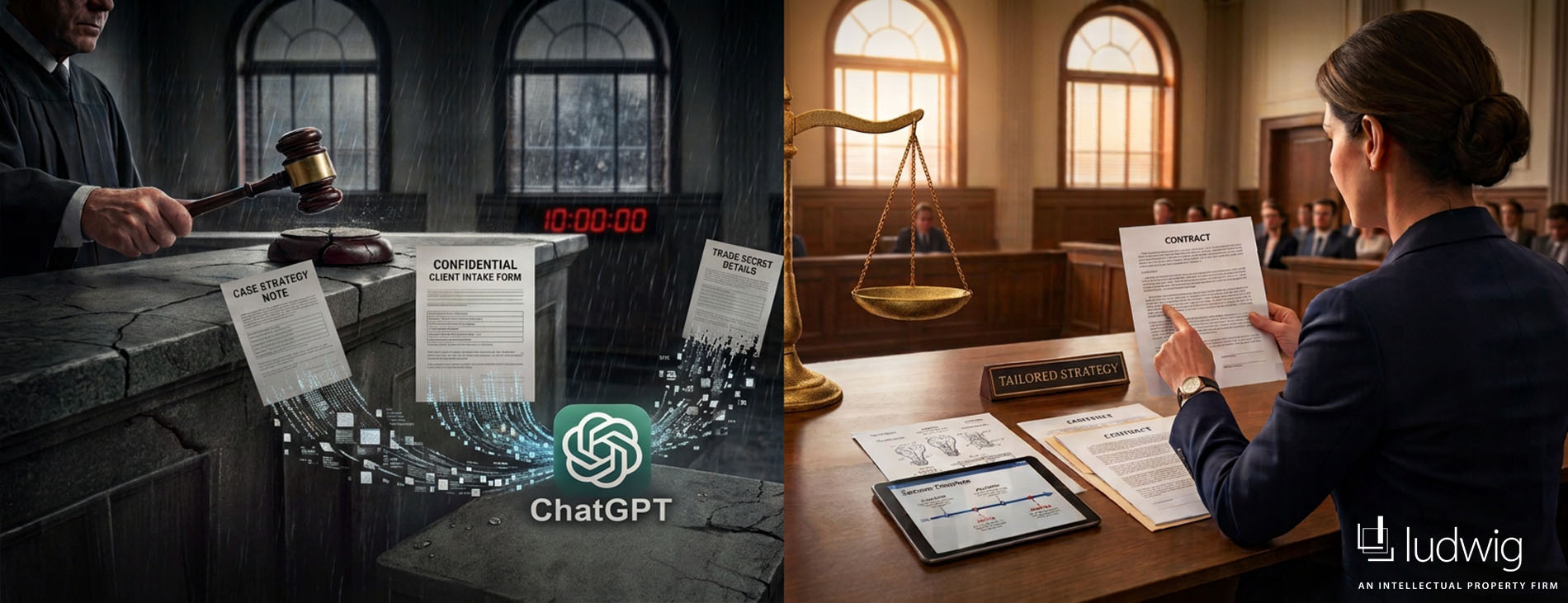
Summary: AI tools like ChatGPT have made legal information more accessible than ever, but “free” answers could come with hidden costs in a real IP dispute. This post takes you through a few considerations, such as why general AI-generated information often falls short when facts, deadlines, and confidentiality are on the line, and where the risks add up quickly. It also outlines the situations where professional judgment matters most.
Key Takeaways
- ChatGPT can explain concepts and help you organize questions, but it cannot evaluate the facts of your dispute.
- IP outcomes hinge on details like contracts, evidence, timing, and jurisdiction that general information cannot weigh.
- “Free” answers can carry real costs, from outdated standards to errors that are expensive or impossible to reverse.
- Details entered into public AI tools may not stay private. Attorney-client privilege does not apply to a chatbot.
- Infringement claims, cease-and-desist letters, deadlines, and high-value disputes are moments to call an IP litigator.
- Use AI to prepare and get organized, but rely on a qualified litigator for tailored guidance.
You are staring down a possible intellectual property dispute. Instead of picking up the phone, you open ChatGPT and type your situation. Within seconds, you get a response that sounds confident, polished, and remarkably authoritative. It feels like free legal advice from ChatGPT. For a moment, it seems like the problem might just solve itself.
However, IP disputes rarely work that way. Whether you are dealing with a copyright claim, a trademark conflict, a patent infringement, or a trade secret concern, the outcome often hinges on facts, evidence, jurisdiction, contract language, deadlines, and the prior conduct of everyone involved. An AI chatbot can’t weigh any of that the way a seasoned IP lawyer can.
This post walks you through a few considerations about where you can use AI legal advice, where it tends to fall short, and when consulting an IP litigator is necessary.
| What This Means: Use ChatGPT to get oriented and ask smarter questions, but do not treat it as legal advice for a real IP dispute. When money, deadlines, or your rights are on the line, a qualified IP litigator can catch the details a chatbot will miss and protect you from costly, irreversible mistakes. |
Where ChatGPT Helps and Where It Falls Short
AI tools have genuine uses for people learning about intellectual property. According to Clarivate’s 2025 report, The Evolution of AI in IP: Adoption, Impact and Readiness, AI adoption among IP professionals increased from 57% in 2023 to 85% in 2025.
While AI use has increased, the trouble starts when general information is treated as a legal conclusion. Knowing what these tools do well and where they stop being reliable helps you use them sensibly.
General Information AI Can Provide
Relying on free legal advice from ChatGPT for background reading is reasonable when you keep its role limited. It can help you:
- Explain common IP terminology such as “infringement,” “licensing,” or “fair use.”
- Identify general legal concepts and how they typically fit together.
- Organize the questions you want to raise with counsel.
- Summarize publicly available information in plain language.
Used this way, an AI tool works like a starting reference. It can shorten your learning curve before a conversation with an IP litigator.
Important Limitations of AI-Generated Legal Information
The limits of AI legal advice deserve equal attention. A language model:
- Cannot represent you or act as your attorney.
- Cannot independently investigate the facts or evidence in your dispute.
- Cannot evaluate the complete factual record specific to your situation.
- May provide incomplete, outdated, or overly generalized information.
- Cannot take responsibility for litigation strategy or procedural decisions.
- Could state something false or present an inaccurate claim as fact.
That last point deserves attention. A confident tone is not the same as accuracy. AI tools can produce plausible-sounding statements that are simply wrong, and users may not know when an answer is inaccurate.
| The Fine Print AI Misses: IP disputes rarely turn on general rules. They turn on facts, timing, and jurisdiction. AI can summarize the law in broad strokes, but it cannot read your contracts, weigh your evidence, or spot the exception that decides your case. |
Why IP Disputes Require More Than General Legal Information
On average, there are between 5,000 and 6,000 patent case filings in the US per year. However, no two disputes are alike. They may look similar but might reach opposite outcomes because of a single detail. That is because intellectual property claims are fact-driven. General information cannot account for that, which is where a seasoned IP litigator adds value.
H3: IP Claims Depend on Specific Facts and Evidence
The analysis of any IP infringement claim changes depending on the type of right involved:
- Copyright: Questions about authorship, registration timing, originality, and access.
- Trademark: Priority of use, likelihood of confusion, geographic scope, and channels of trade.
- Patent: Claim construction, prior art, and the technical specifics of the invention.
- Trade secret: Did the party take reasonable steps to keep the information confidential?
- Ownership and licensing disputes: Who holds the rights, and what any agreement actually permits.
Each category rewards different evidence. Generalized information gathered using AI cannot weigh which facts carry legal significance in your matter.
H3: Jurisdiction, Contracts, and Timing Can Change the Analysis
In many similar-looking IP disputes, the same set of facts can produce different results depending on:
- Applicable law in the relevant jurisdiction.
- Precise contract language governing the relationship.
- Who owns the intellectual property in question.
- Prior actions taken by either party.
- Deadlines and procedural requirements that may already be running.
Sometimes, a small variation in any of these can reverse the practical answer. An experienced IP litigator can identify how these details may affect your claims, defenses, and available options.
H3: Litigation Strategy Requires Evaluation of the Entire Dispute
A capable IP litigator looks at the whole picture, not one question in isolation. That evaluation includes:
- Pros and cons of each claim and defense.
- The evidence available to each side.
- Your business objectives and appetite for risk.
- Potential costs and financial exposure.
- Pre-litigation options versus formal litigation.
Strategy lives in these trade-offs. General information cannot balance them because it does not know your goals or your evidence.
| Context Is Everything: The same IP question can have completely different answers depending on your industry, contracts, and prior filings. General information ignores that context, while an IP litigator builds the strategy around it. |
H2: How AI-Generated Legal Information Could Become Expensive
The word “free” describes the query, not the consequences. Taking a step guided by generalized information from an AI tool could cost far more than an early consultation would have. Here is why:
H3: Laws and Legal Standards Can Change
Legal information ages quickly. When getting free legal advice from ChatGPT or any other AI tool, you should consider the following:
- Statutes and regulations get amended.
- Case law evolves as courts issue new decisions.
- Jurisdiction-specific requirements vary and update over time.
If the AI model was trained on older material, it may repeat legal standards that no longer apply. Acting on outdated information is one of the reasons this “free” answer could turn costly.
H3: Important Facts May Be Missing
Whether it is ChatGPT, Gemini, or Claude, every AI tool works only with what the user provides and with its training data. When you use AI legal advice, this could lead to two major problems:
- A seemingly minor fact can materially change the analysis.
- Many business owners do not know which facts carry legal weight, so they leave them out of the question entirely.
The result is an answer that fits the wrong version of the story. However, an IP litigation lawyer asks the follow-up questions AI might not ask.
H3: An Incorrect Response Can Affect Future Litigation
Decisions made on faulty information can echo through a later IP dispute. Here are a few considerations in this regard:
- Sending a “Cease and Desist” letter or a poorly worded response.
- Missing a deadline that could not be recovered.
- Making written statements that become relevant evidence later.
- Taking steps that complicate a future claim or defense.
Once a letter goes out or a deadline passes, it can considerably narrow down your legal options. Some early moves are often difficult or impossible to undo.
| “Free” Has a Price Tag: The word “free” describes the query, not the outcome. A single wrong move, an outdated standard, a missed deadline, or a demand letter sent too soon could cost far more than an early consultation ever would. |
H2: Confidentiality Is Another Consideration When Using AI for Legal Questions
The AI and privacy debate has intensified in the past couple of years. AI tools are data-hungry and intransparent. Still, privacy considerations could get overlooked. Information entered into a public AI tool may be stored or used in ways you do not control. That raises concerns about:
- Sensitive business information.
- Trade secrets and proprietary details.
- Attorney-client privilege, which generally does not attach to a conversation with a chatbot.
Before typing confidential details into any AI tool, consider carefully what you are disclosing. Sharing proprietary information with a public model could weaken protections you later wish you had kept intact. Communications with an IP lawyer, by contrast, are protected under attorney-client privilege.
| Once It’s Typed, It’s Out There: Depending on the AI tool, account type, and privacy settings, information entered into an AI system may be stored, reviewed, or used for service improvement. Before sharing sensitive information, review the provider’s current privacy and data-use policies. |
H2: Considerations When Professional IP Litigation Counsel May Be Worth Exploring
General information has its place, and knowing when to move beyond it is part of using these tools wisely. Certain situations point toward a conversation with a competent IP litigator.
H3: Circumstances That May Warrant Legal Counsel
Consider reaching out to an IP litigation lawyer when you face:
- An actual or threatened infringement claim.
- A cease-and-desist letter, whether you received one or intend to send one.
- A potential dispute involving significant business value or exposure.
- A deadline that could affect your IP rights.
- A licensing or ownership question linked to a real transaction.
These are moments where the cost of a mistake could exceed the cost of professional legal advice. A quick consultation can clarify your legal options before you commit to a course of action.
| When Legal Counsel May Be Worth Considering: If you are facing an infringement claim, a cease-and-desist letter, a filing deadline, or a high-value dispute, that is the moment to bring in an IP litigator. The earlier you involve counsel, the more options you keep on the table. |
H2: When It May Be Worth Consulting an IP Litigator
Getting free legal advice from ChatGPT sounds convenient and straightforward until it is not. Free AI tools are useful for learning legal vocabulary, organizing questions, and getting oriented. They are not a replacement for professional legal advice tailored to your facts, evidence, and deadlines.
When facing an IP dispute or a deadline, it is best to speak with an IP lawyer who can evaluate your situation. At Ludwig IP Law, we help business owners, inventors, and entrepreneurs understand and assert their intellectual property rights. Our team can help you weigh your options with your facts in view.
We offer a free, no-strings-attached consultation. Contact us through our website, call (619) 929-0873, or email consultation@ludwigiplaw.com to schedule yours.
Frequently Asked Questions
- Can ChatGPT give me reliable legal advice for an IP dispute?
- ChatGPT can explain general concepts and help you frame questions, but it does not know the facts, contracts, or deadlines in your case. For anything with real stakes, it is best to speak with a qualified IP litigator.
- Is it safe to enter case details into an AI tool?
- Generally, no. Information typed into public AI tools may be stored or used to train the model, and it is not protected by attorney-client privilege. Sensitive details are safest shared directly with an IP litigation lawyer.
- Why can AI-generated legal information become expensive?
- AI can state outdated standards or confidently present errors as fact. Acting on that, such as missing a deadline or sending a demand letter too early, could lead to costs that far outweigh an initial consultation.
- When should I actually consult an IP litigator?
- Consider reaching out if you are facing an IP infringement claim, a cease-and-desist letter, an approaching deadline, or a high-value dispute. Involving counsel early usually keeps more options open.
- Is using AI for legal questions ever a good idea?
- It can be, as a starting point. Using it to learn terminology or organize your thoughts is reasonable, but it should not replace advice from a professional who understands your situation.